

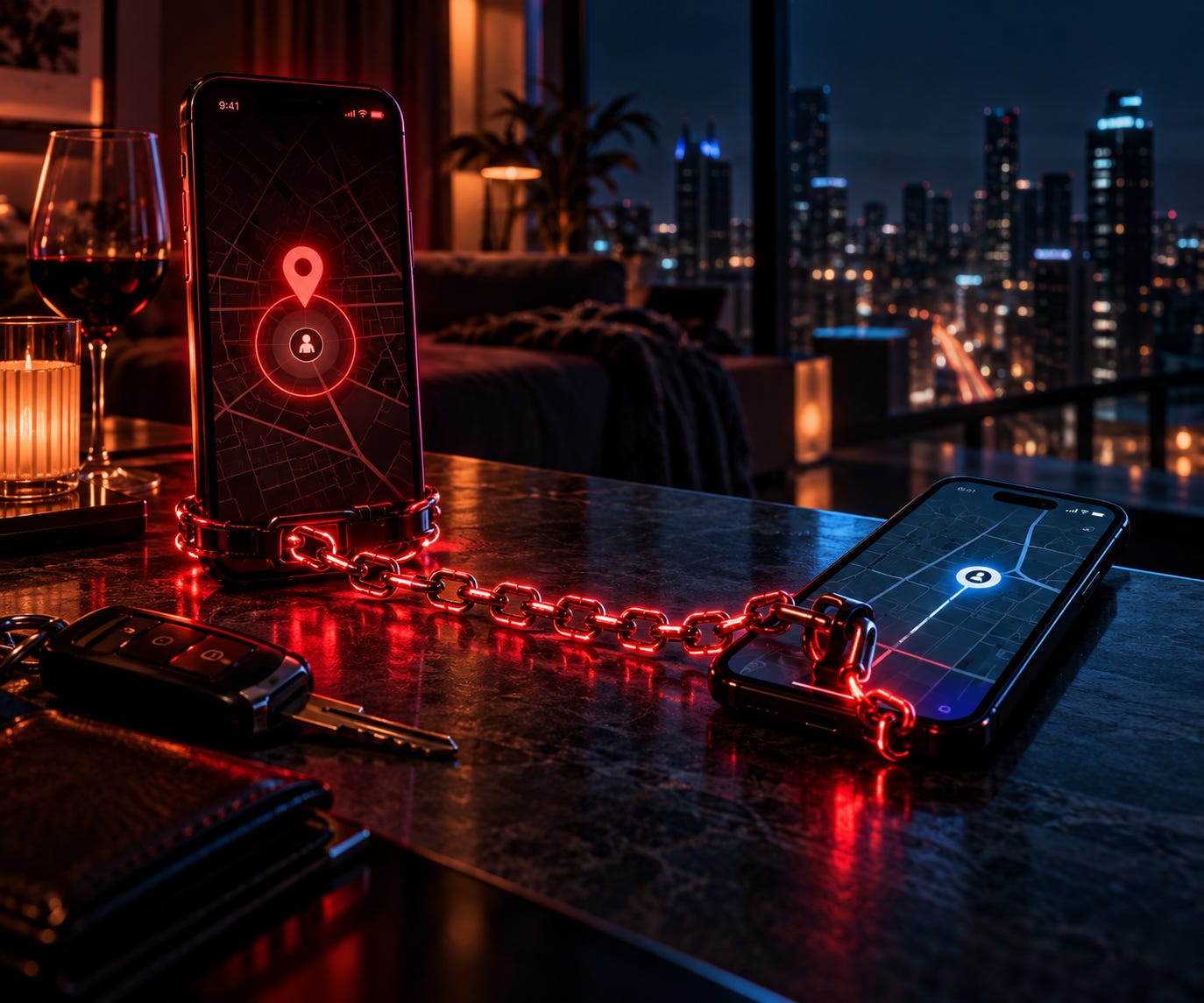
It started shortly after we got engaged.
We were leaving my parents’ house when she looked over and said, almost casually:
“You should share your location with me on Find My.”
I asked the obvious question.
“Why?”
“For safety.”
Ahh. Of course.
The answer came so quickly it sounded rehearsed. I felt a lump in my throat. I wanted to argue, but I was already too deep into the relationship to turn something this small into a confrontation. We were going back to our one-bedroom apartment together, and I didn’t particularly feel like spending the rest of the evening trapped in 700 square feet with a pissed-off fiancée.
Besides, refusing created its own problem. If I went somewhere later to blow off steam and she couldn’t see where I was, that would simply reinforce why she thought she needed my location in the first place.
Nice double bind.
It wasn’t really the app that bothered me. It was what came after. Location sharing rarely stays a convenience. It gradually becomes the new baseline.
I already knew how saying no would sound.
“Why not?”
“What do you have to hide?”
So I shared it.
I figured this was just part of the standard bullshit tax you pay for being in a relationship. Pick your battles. Surrender your coordinates. Keep the evening moving.
A week or two later, we were visiting her parents’ lake house. I decided to test the waters.
“She wanted my location,” I mentioned casually.
Her mom didn’t hesitate.
“That’s what we do in this family.”
Dafuq?
It wasn’t just her preference. It was part of the family culture. Permanent access to each other’s whereabouts was normal.
I should’ve paid more attention to that.
I didn’t.
The Pattern Emerges
Years later, I’d met a guy at a baby shower. He was engaged. I was the married dad with a wife and newborn daughter—the life many people assume they’re working toward.

Then I got divorced.
By coincidence, we later became neighbors. As we caught up, he told me his fiancée had recently called off their engagement.
One detail caught my attention.
She had wanted his location too.
One afternoon, he’d given a longtime friend who happened to be a lesbian a ride to the airport. Nothing romantic. Just a favor.
His location showed him at the airport.
Then the questions started.
“Why were you at the airport?!”
The app hadn’t uncovered a betrayal. It had created an event that now required an explanation.
Without location sharing, he drops his friend at the airport and continues with his day. With location sharing, the same innocuous trip becomes a data point. The data point produces suspicion. The suspicion produces questions. The questions produce a fight.
Nothing happened at the airport.
But the app still managed to create an incident.
At first, I thought our experiences were unrelated. Then I noticed the assumption underneath both of them:
Trust wasn’t something to be given. It was something to be continuously verified.
Verification Isn’t Trust
One of my go-to thinkers on relationships is Dr. Orion Taraban.

He makes a simple observation:
Surveillance is a form of disrespect.
It sounds harsh until you ask why surveillance is necessary in the first place. If I trust you, I don’t need 24/7 access to your whereabouts. If I don’t trust you, the relationship has a different problem altogether.
A phone can’t solve either one. It can only automate the checking.
Verification can easily masquerade as trust. Someone may say, I trust you because I can see where you are.
But that’s not trust. That’s certainty.
Trust exists precisely because certainty doesn’t.
You tell me you’re going somewhere. I’m not gonna monitor every step afterward. I tolerate that uncertainty because I believe what you told me.
Location sharing removes some of that uncertainty. At first, that feels reassuring. Then reassurance becomes available on demand.
And once reassurance is available on demand, not having it can start making people nervous.
Assistance vs. Surveillance
None of this means location sharing is inherently sinister.
Safety is a legitimate reason to let someone know where you are. I’ve temporarily shared my location with a friend after having a couple drinks and riding my e-bike home. The point wasn’t for him to know where I was forever. It was to make sure my drunk ass got home without becoming roadkill.
Once I got home, the purpose disappeared.
The same logic applies when someone is driving a long distance, hiking alone, traveling late at night, or meeting a stranger for a first date. There’s a specific risk, a reason for sharing, and a natural point when access ends.
That’s assistance.
Permanent tracking is different because there’s no terminating event. The access exists whether there’s a problem or not.
One says:
Let me see where you are because something unusual is happening.
The other says:
Let me always be able to see where you are in case something unusual happens.
Those sound similar on the surface, but they’re fundamentally different.
One responds to uncertainty. The other attempts to eliminate it.
The Panopticon in Your Pocket
There’s something uncomfortable about knowing you’re being tracked. Your movement no longer feels entirely private. You’re not exactly a house pet with an AirTag strapped to your collar, but you’re headed in that direction.
Actually, the dog might have the better deal. His tracker has a limited range.

It’s like using a work laptop when you know monitoring software is installed. You may not be doing anything wrong. Nobody may even be watching. But you know they can, and that possibility changes the experience.
You stop being merely a person moving through the world. You become a dot on someone else’s screen.
A stop at a store is visible. An unusual route is visible. Staying somewhere longer than expected is visible. Mundane behavior starts generating data.
Your behavior hasn’t necessarily changed.
Its observability has.
That creates a strange paradox. The person who wants permanent location sharing because it reduces anxiety may also be the person most likely to check it repeatedly.
You’re checking your crypto portfolio. She’s checking your location.
Every check creates another opportunity to find something ambiguous. Every ambiguity creates another reason to ask a question. Every unanswered question creates another reason to check.
The reassurance mechanism becomes the suspicion mechanism.
The Desire to Disappear
Now for the inconvenient part.
I was already cheating before my then-fiancée slapped me with location tracking. She probably already knew I was a shady character, which may have been part of why she wanted it in the first place.
So I’m not going to blame Find My for turning an otherwise faithful man into an international man of whoredom. That operation was already underway.
But being tracked did something else.
It made me want distance more.
When somebody can see where you are, expects to know what you’re doing, and can potentially question every moving blip on the map, regular independence feels illicit. You begin craving places where you’re off the grid.
For me, cheating became one of those places.
That’s not an excuse. I wasn’t cheating because Find My made me cheat. I was cheating because I chose to cheat.
But surveillance added another reward to behavior I was already engaging in: disappearance.
For a few hours, I wasn’t the fiancé being monitored. I wasn’t accountable to the household itinerary. I was somewhere else, doing something nobody in my normal life knew about.
That secrecy had its own rush.
There’s a broader mechanism underneath my shitty behavior, though.
Attraction needs some distance.
Not deception. Not manufactured jealousy. Not pretending you’re Jason Bourne because you went to Krispy Kreme without telling your girlfriend.
Distance.
Two people need enough separation to remain two people: separate experiences, separate thoughts, parts of the day the other person didn’t witness. Things you can actually come home and tell each other because neither of you watched them happen through a screen.
Complete transparency can look like intimacy because it produces more information. But information and intimacy aren’t the same thing.
Sometimes knowing less gives the other person somewhere to return from.
Mystery doesn’t require secrets.
It requires space.
Technology Raises the Baseline
There was a time when leaving the house meant becoming temporarily unavailable.
Your partner might know where you were going and roughly when you’d be back. But unless they started ringing up restaurants and landlines like a private investigator, there were limits to what they could know.
Those limits weren’t concerning. They were normal.
Then technology gradually removed them.
Texting made immediate responses possible. Read receipts revealed whether someone had seen your message. Social media made other people’s activities visible. Location sharing made someone’s whereabouts available in real time.
The technology created the capability. The expectation came later.
Once information becomes effortless to provide, refusing to provide it starts requiring an explanation.
Why don’t you have Instagram? Why did you turn off your read receipts? Why can’t I see your location?
The technology changes first. Then the etiquette accommodates it.
Eventually, yesterday’s normal amount of privacy starts looking suspect.
Access Becomes the Baseline
This is where the Cyber Leash actually forms.
Not when someone first asks for your location, but when permanent access becomes normal.
Once you’ve shared your location for six months, turning it off no longer feels like returning to the original deal. It feels like removing something substantial.
Before location sharing:
“Why would I need your location?”
After location sharing:
“Why did you turn your location off?”
Nothing necessarily happened between those two questions. The baseline changed.
Yesterday, privacy was ordinary. Today, privacy starts looking like a violation.
And violations require justification.
That’s how a convenience becomes an expectation without either person explicitly agreeing that permanent access is now a condition of the relationship.
Nobody signed that contract.
The terms just changed.
Reciprocity Doesn’t Solve It
The obvious counterargument is:
“She shares her location with me too.”
Sounds good.
But reciprocity doesn’t automatically change the nature of the arrangement. Two people can grant each other identical access while using that access completely differently. One person might forget location sharing is even turned on. The other might check it five times before lunch.
It isn’t necessarily about gender. It’s usually about who needs more reassurance.
The arrangement may be mutual. The monitoring rarely is.
Even if both people checked equally, reciprocity still wouldn’t answer the underlying question.
Imagine a couple expecting unrestricted access to each other’s browser histories, email accounts, text messages, and ChatGPT conversations. That doesn’t suddenly become extraordinary trust because both people agreed to it.
It’s extraordinary access.
Those aren’t the same thing.
Location sharing operates on the same principle. Equality may make the arrangement reciprocal, but it doesn’t make verification trust.
The Removal Test
There’s a simple way to find out whether location sharing is merely a convenience or has become something more.
I call it the Removal Test.
Turn it off.
Not secretly. Not during some suspicious three-hour excursion to a Motel 6. Just decide you no longer want to broadcast your location continuously.
If your partner asks why, explain your decision.
Then watch what happens.
If they accept it, maybe location sharing really was just a convenience.
But if your decision produces an argument, accusations, or a phone that won’t stop blowing up—
“Where are you going?”
“What are you hiding?”
“Why won’t you turn it back on?”
—then the location wasn’t merely information anymore. It had become reassurance, and that reassurance had become expected.
That’s the part nobody notices when they first press Share Indefinitely.
Access tells you what someone enjoys having.
Removal tells you what they believe they’re entitled to.
The Zaddy Law
Trust is the willingness to tolerate uncertainty. The more a relationship depends on monitoring, the less it depends on trust.
The Cyber Leash doesn’t feel like a leash the day you put it on.
It feels like one the day taking it off starts a fight.

PS: I’m opening a few private 1:1 sessions for guys rebuilding after a breakup or divorce. Structure, dating, routines, fatherhood, money, or just figuring out what the hell comes next.
No program. No therapy-speak. Just a private conversation about where you are and where you’re trying to go.
The Zaddy Codex is where the framework comes together.
Tactical essays on power, relationships, fatherhood, and rebuilding after the script breaks.
🔒 Join the paid tier to unlock the complete Codex library.
From the Vault:


Poison for the Heart • The Heartiste Maxims • The Desi Playboy Manual • The Bonecrker Codex — free download
Z-Ledger:
A private net worth & financial clarity tool I use to track the rebuild.
Launch →
I’ve written about location sharing.
My ex asked for it once. “I don’t want to be tracked like an animal,” I responded.
“You’re nuts,” he said.
“I want to be free. I can’t live my life like that.”
The Panopticon reference was genius. Loved this piece.